Back to Blog Library
Article
How to Teach AI SEO and GEO Like a Pro

Today’s brands have to think past claiming the top spot in traditional search. They need to show up in LLM responses and AI chats. This market evolution is happening fast, which raises a question for educators:
How do you teach students this new SEO reality and give them the skills they need for their careers?
In the Stukent webinar “How to Teach AI SEO and GEO Like a PRO,” industry experts Dr. Scott Cowley and Steve Wiideman shared a three-part framework for bringing these changes into the classroom.
Part 1: Help Students Rethink Search
Part 2: Classroom Concepts, Activities, and Assignments
Part 3: SEO Tools Students Can Practice with Today
Part 1: Help Students Rethink Search
Search has evolved from a single-channel keyword search into a multi-platform discovery process that includes AI assistants, social media, and generative engines. For Gen Z and Gen Alpha, search may start on TikTok or Instagram instead of Google, while some AI assistants can now take action on a user’s behalf, such as ordering food through a maps app.
As the places people search change, so does what students need to learn. It’s important that students know that SEO isn’t leaving; it’s just not the only focus. Two important new terms for this mindset shift are AEO and GEO.
Answer Engine Optimization (AEO) is all about technical work that helps AI systems access, read, and use website content in generated answers.
Generative Engine Optimization (GEO) focuses on getting your content and brand cited and linked to by AI platforms.
SEO is where you rank, AEO helps you get found, and GEO is what gets cited.
Part 2: Classroom Concepts, Activities, and Assignments
Understanding how search is changing is one thing. Helping students see why those changes matter to their careers is another.
Moz’s AI Search Skills Report, which analyzed SEO job listings to identify how AI is changing industry skill requirements, found a few trends you can bring into the classroom:
50% of SEO job descriptions now mention AI in some capacity.
AI skills appear more often in senior-level SEO roles than entry-level positions, showing that this trend is moving up the career ladder.
Local businesses need a rating of 4.5 stars or higher to reliably appear in AI-generated search results.
Analytics and tracking are among the most common AI-related skill requirements in SEO job listings. It’s not just about prompting or AI strategy. Students also need to know how to measure results.
These trends give students context, but hands-on activities can help make the concepts stick. The following exercises give students a chance to explore how AI search works, evaluate what they find, and apply what they’ve learned.
Activity 1: Audit brand accuracy in AI search
Prompt for brand facts: Have students prompt ChatGPT, Gemini, or Claude with questions such as:
“What is [brand/product]?”
“Who is [brand/product] for?”
“What kind of reputation does [brand/product] have?”
“What are the pros and cons of [brand/product]?”
Because LLMs can generate different responses to the same prompt, instruct students to repeat the prompts across multiple AI platforms for accuracy and consistency.
Ask students to flag incorrect, outdated, or unsupported information. Then, have them consider what information an AI system may be missing and what clear, up-to-date website content could help address those gaps.
Activity 2: Audit brand visibility in AI-generated answers
Run "best of" prompts: Ask students to test generic and specific discovery prompts, such as:
“What is the best [product category]?”
“What is the best [product category] for [target market/use case]?”
“If someone in [location] were looking for the best [product category] ...” (to account for geographical and personalized search biases).
Have students identify which brands appear, which sources the AI cites, and what factors seem to influence each recommendation. They can then compare those patterns to uncover evidence or information a brand may need to strengthen its visibility in AI search.
Activity 3: Explore semantic triples and query fan-out
AI search depends on how clearly content communicates information and how well it addresses the related questions a search can uncover. Two concepts can help students explore these ideas: semantic triples, which show relationships among pieces of information, and query fan-out, which shows how a single search can expand into multiple related questions.
Practice semantic triples: Teach students to communicate relationships using a subject-predicate-object structure, such as “Brand X offers Y service.” Then, have them evaluate how clear statements help machines identify relationships between entities and information.
Explore query fan-out: Have students give an AI tool a broad search query and ask it to identify related questions and subtopics a searcher might explore. Students can use those subtopics to plan FAQs, page sections, and descriptive headings that address related search intent. This exercise helps demonstrate how one search can expand into a network of questions that content may need to answer.
Part 3: SEO Tools Students Can Practice with Today
Having students use real platforms and SEO tools in class gives them a frame of reference for the concepts they’re learning. Hands-on experience and practice with these tools helps improve understanding and engagement, and gives students specifics to reference in interviews.
AI chat platforms: ChatGPT, Gemini, and Claude are the most commonly used large language models. Use these and similar tools to run accuracy and visibility audits and see how brands appear in AI-generated answers.
Search and local visibility tools: Help students analyze how reviews, star ratings, and business listings affect local map pack placement and AI recommendations.
Google Business Profile: Audit public competitor listings or campus business profiles in Google Search and Maps to analyze star ratings, review volume, and business categories.
Content and citation analysis tools: Show students whether their writing is structured clearly enough for search engines and LLMs to understand, extract, and cite.
Google Search Console: Review organic search queries, indexing status, and click-through rates to see how Google indexes site content.
Google Analytics: Track referral traffic, user engagement, and conversion paths to evaluate how clear content converts search visibility into user action.
Simternships: Give students a low-risk experience to build and test campaigns and content strategies before they do the same work for a real brand. Explore Simternships.
SEO Has Changed, but the Foundation Is the Same
Search may look different than it did a few years ago, but the foundation hasn't changed. Relevance, popularity, and user behavior remain three core pillars of search.
What has changed is the number of places where brands need to build visibility. Students now need to think beyond a website and consider how a brand appears across YouTube, social media, local maps, and AI chat.
That means teaching SEO isn't just about helping students understand how to rank a page. It's about helping them understand how people discover information, how AI chooses what to recommend, and how brands can earn visibility across that entire journey.
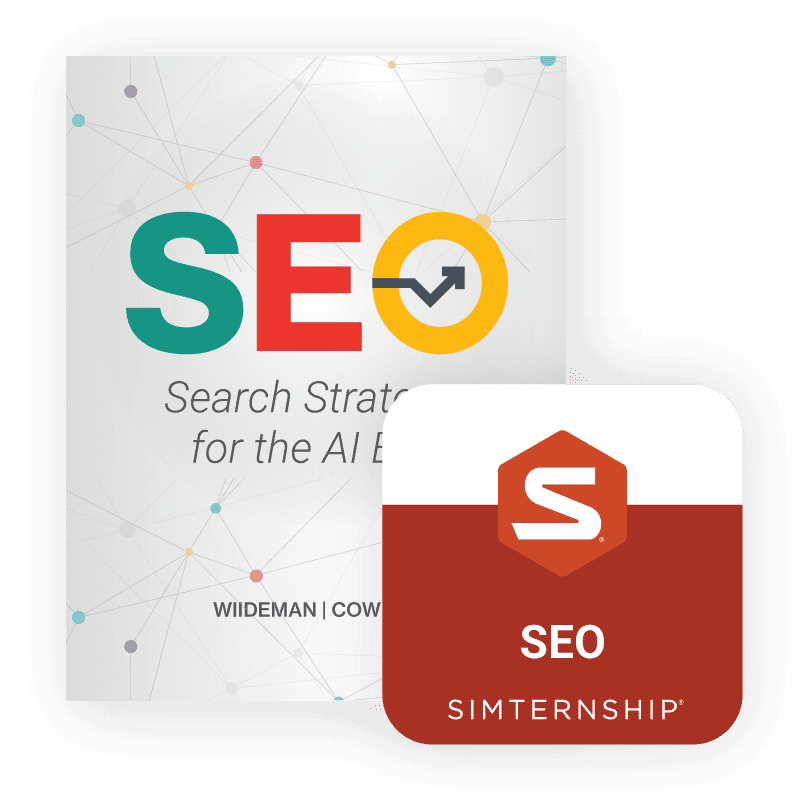
The Stukent "SEO: Search Strategy for the AI Era" courseware provides a way to integrate these ideas into your marketing course. With premade lesson plans, assignments, quizzes, and more, it helps you give students the concepts and practice they need to connect SEO to the way search works today.
Get free instructor access today and see how you can bring the future of search into your classroom.
FAQ: What Key Search Terms Should Students Know?
Q: What is the difference between AI SEO, AEO, and GEO?
AI SEO (Artificial Intelligence Search Engine Optimization) is the broad practice of optimizing content to be discovered, summarized, and recommended by AI-driven search engines and chatbots.
AEO (Answer Engine Optimization) focuses on the technical and structural work (like FAQ schemas and clean semantic HTML) that helps AI engines (like ChatGPT or Perplexity) easily crawl, read, and use website content in their direct conversational answers.
GEO (Generative Engine Optimization) focuses on optimizing content so that generative search experiences, like Google's AI Overviews, cite and link directly to your brand as a source.
Q: What is a Large Language Model (LLM)?
A Large Language Model (LLM) is an AI system trained on massive amounts of text data to understand, generate, and predict human-like language. Search engines use LLMs to interpret conversational search queries, synthesize information, and draft direct answers for users.
Q: What is Retrieval-Augmented Generation (RAG)?
Retrieval-Augmented Generation (RAG) is the framework AI engines use to ground their answers in real-time web data. When a user submits a prompt, the AI first retrieves live, relevant source pages from the web, and then uses that retrieved information to generate a cited response, preventing hallucinations and ensuring current accuracy.
Q: What does E-E-A-T stand for, and why is it important in AI search?
E-E-A-T stands for Experience, Expertise, Authoritativeness, and Trustworthiness. AI search engines prioritize content that displays clear E-E-A-T signals (such as named author bios, expert credentials, original research, and reliable first-party data).
Q: How does query fan-out affect content creation?
Query fan-out is the process where an AI engine breaks down a user's broad search intent into multiple narrower, related subqueries and follow-up questions. For content creators, understanding query fan-out helps identify exactly which related questions to address as FAQs or subheadings on a page to match how AI maps out topics.
Q: What is ORM in the context of SEO, and how does it relate to AI?
In the digital marketing and SEO space, ORM stands for Online Reputation Management (not the programming concept Object-Relational Mapping). In the AI search era, ORM is about managing how your brand is perceived across user-generated content (UGC) channels like Reddit, YouTube, and review sites. Because AI search engines heavily analyze public sentiment and brand mentions across these platforms to make recommendations, monitoring your brand's digital footprint is key to modern search visibility.